
Campus visits, done properly
Xploration Tours
Vetted, itinerary-driven college visits where scholars meet faculty, sit with campus ambassadors, and leave knowing whether they can see themselves there.

- Local tour
- $75 per scholar
- Selection
- By eligibility and interview
- Built with
- Host college admissions and faculty
- Out of state / international
- Quoted per itinerary
Why a campus visit decides more than a brochure ever will
There is a version of the college search that happens entirely on a screen. A student reads rankings, scrolls a photo gallery of a quad in autumn, watches a two-minute admissions video scored to acoustic guitar, and forms an opinion about a place they have never stood in. That version is cheap, convenient, and consistently wrong, because the things that determine whether a student thrives at an institution are almost entirely invisible from the outside.
Whether the campus is walkable at night. Whether the dining hall is somewhere people linger or somewhere people flee. Whether the professor teaching the introductory course in the student's intended major is engaged or exhausted. Whether students who look like the visiting scholar are present in numbers, and whether they seem to be having a good time. Whether the tutoring center is staffed at eight in the evening, when students actually need it. None of that is in the brochure, and all of it shows up in the second semester of freshman year as a retention statistic.
For first-generation students specifically, the visit does something else. It converts college from an abstraction into a place. A scholar who has physically walked through a residence hall, eaten in the dining commons, and asked a real question of a real professor has a mental model of what they are working toward. Students with that model persist through the parts of the application process that make students without it quietly give up. The Foundation has watched this happen enough times to treat campus visits as a core academic intervention rather than a field trip.
The other half of the argument is financial. A student who chooses a college they have never seen, and then transfers or withdraws after a year, has typically spent a year of eligibility and a meaningful amount of borrowed money to learn something a $75 tour would have told them. Xploration Tours are, in the most literal sense, the cheapest due diligence available in the entire college process.
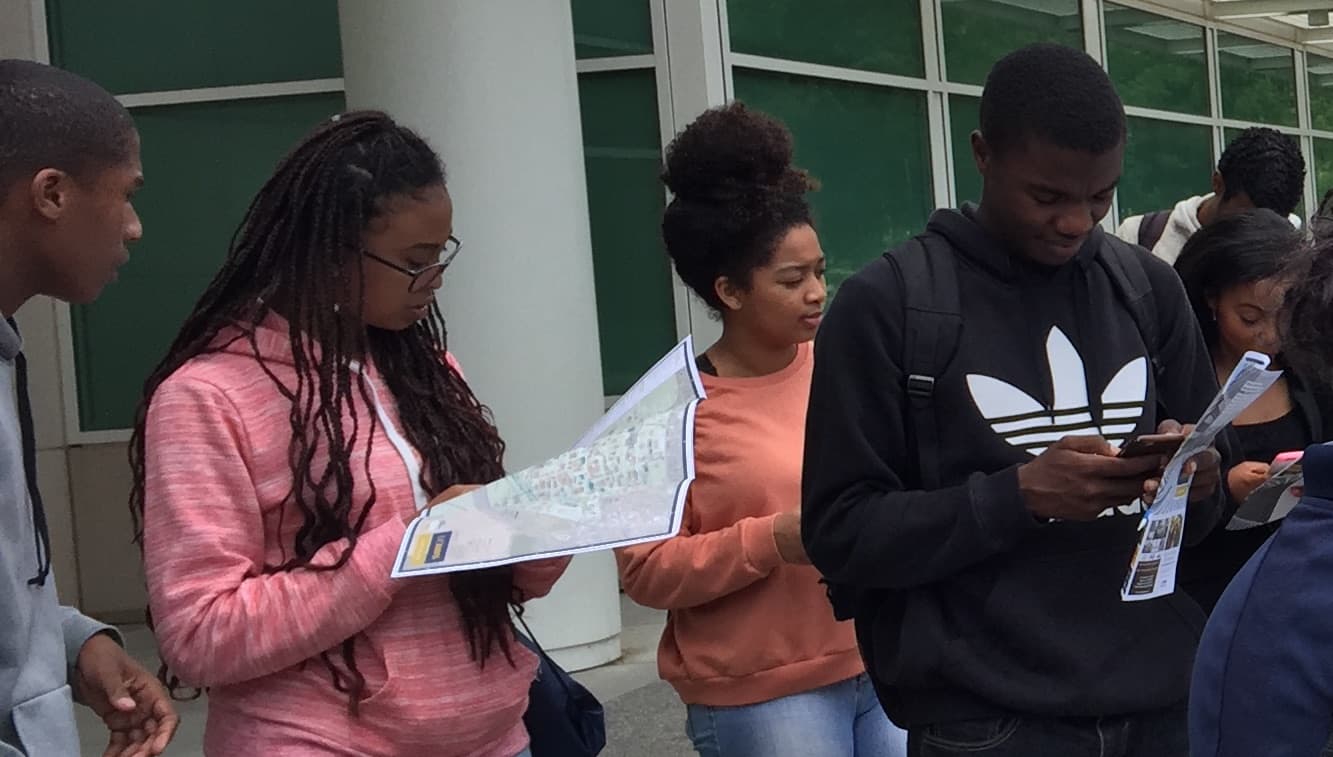
How a WHD tour is built
The distinction that matters is between a tour a family books and a tour the Foundation builds. Anyone can register for a public campus visit: a student joins forty strangers, walks backward behind a sophomore for ninety minutes, hears the same eight anecdotes every group hears, and leaves. That experience has some value. It is not what WHD is charging for.
A WHD Xploration Tour begins weeks earlier with the host institution. Foundation staff work directly with campus admissions offices and, where possible, with faculty in the departments our scholars have named as interests. The itinerary is written for the specific group traveling, a cohort weighted toward nursing does not get the same day as a cohort weighted toward engineering and computer science. Host colleges know who is coming, what year they are in, and what they want to know, and they staff the visit accordingly.
Every itinerary is vetted before it is published to families. Vetting means the Foundation has confirmed the schedule, the supervision ratio, the transport, the meal arrangements, the accessibility of every location on the route, and the emergency plan. Scholars traveling are minors in the Foundation's care, and the operational side of that responsibility is treated as seriously as the educational side.
A written itinerary, in advance
Families receive the full day, timings, locations, contacts, transport and supervision, before they consent to the trip.
Faculty contact
Where the host institution can arrange it, scholars meet a professor in a department they are actually considering, not a generalist.
Campus ambassadors
Time with current students, unscripted, including meals. This is where the honest answers come from.
Admissions conversation
A real discussion of what this institution looks for, what it costs after aid, and what a competitive application from our scholars looks like.
Financial-aid grounding
Net price, not sticker price. Scholars leave able to estimate what the place would actually cost their family.
A debrief
The tour is not finished when the bus gets back. Scholars record impressions and work them into their college list with their advocate.
Eligibility, the interview, and why seats are limited
Participation is based on eligibility and an interview. That sentence tends to surprise families who expect a tour to be a purchase, so it is worth explaining the reasoning rather than just stating the rule.
First, host institutions extend real access, faculty time, admissions staff time, ambassador time, on the understanding that the visiting group is prepared and serious. That relationship is the whole reason a WHD tour is better than a public one, and it is maintained by sending scholars who are ready to use it. A student who arrives with no questions and no interest in the institution costs a future scholar the access.
Second, seats are genuinely finite. A campus can host a group of a certain size on a certain day, and supervision ratios for minors cap it further. When more scholars want a tour than the day can hold, priority goes to Cradle to Career scholars, then to students for whom the specific institution appears on their working college list, then by interview.
Third, the interview is short and is not an obstacle course. A staff member asks the scholar why this campus, what they want to find out, and what they would do with the answer. Students who cannot answer yet are not rejected. They are usually redirected to a tour that fits them better, or asked to come back after their next advocate session with a clearer question. The purpose is to make sure each scholar boards the bus with something specific they are there to learn.

Local, out of state, and international
Local tours are the backbone of the program and the reason the per-scholar price can stay at $75. Transport is short, the day is a single day, and the Foundation's standing relationships with regional institutions mean the itinerary quality is highest here. Most scholars should see three or four local campuses before they seriously consider traveling further, because the local cycle teaches the comparison skill that makes a distant visit worth the money.
That comparison is the entire point of the multi-tour pricing. One campus visit produces an impression. Four produce a framework. A scholar who has walked a large public research university, a small liberal-arts college, a regional comprehensive and an HBCU within the same academic year can articulate what they actually want from an institution in a way no amount of reading achieves. At $300 for four or more, the full local cycle costs less per campus than a single tour does.
Out-of-state and international itineraries are quoted separately because travel and lodging drive their cost, and the Foundation quotes those components at cost rather than marking them up. These trips are built for scholars whose college lists have genuinely outgrown the region, a student targeting a specific program, a scholar with an offer worth evaluating in person, a cohort visiting institutions that have historically recruited from our community. They require longer lead time, additional consent, and in the international case, documentation that families should begin gathering months ahead.
How scholars prepare, and what families should expect
A tour is worth what a scholar brings to it. Advocates prepare scholars in the session before travel: what this institution is known for, what its admissions profile looks like, what its net price tends to be for a family in a similar position, and what three questions this particular student should ask. A scholar who asks a professor a specific question about undergraduate research placement gets an answer that reshapes their list. A scholar who asks nothing gets a nice walk.
Families should expect paperwork before travel, and it is not negotiable: the parent or legal caregiver consent and release, medical information and emergency contacts, and photo consent. These are the same forms that govern every WHD activity involving minors and they must be signed before a scholar boards. Families should also expect a supervision ratio appropriate to the group and the destination, named staff contacts for the day, and a specific return time.
What families should not expect is a sales pitch. The Foundation has no financial relationship with any host institution and receives nothing if a scholar enrolls. Advocates will tell a scholar plainly when a campus they loved is a poor financial fit, and will tell them equally plainly when a campus they dismissed deserves a second look. The tour is a research instrument, and its value depends entirely on the Foundation having no stake in the conclusion.

The investment
Tour pricing is per scholar and steps down as a family commits to more of the cycle, because a scholar who sees four campuses learns something a scholar who sees one cannot. Local tours are fully customized and meticulously vetted with detailed itineraries. Participation is based on eligibility and an interview. Out-of-state and international tour investments vary with travel and are quoted per itinerary.
1 tour
$75
per scholar
2 tours
$150
per scholar
3 tours
$225
per scholar
4+ tours
Most chosen$300
per scholar
The full local cycle
Out of state / international
By arrangement
per itinerary
Varies with travel and lodging
- Cradle to Career scholars receive priority placement when seats are allocated.
- Eligibility and an interview are required. Tours involve minors traveling under Foundation supervision, and seats are limited by what the host campus can accommodate.
- Tour fees cover the itinerary, coordination and on-site supervision. Long-distance travel and lodging are quoted separately and at cost.
Scholarships are available
A scholarship reduces or covers what a family pays toward the investments below. Applying is free, winning is free, and no award is ever conditioned on a purchase. Tell us about yourself to get started.
What you should be able to point at
- First-hand comparison of several institution types, not a single impression
- Named contacts in admissions and, where arranged, in an academic department
- A realistic sense of net price at each campus visited
- A college list revised on evidence, with the scholar able to say why each school is on it
Questions families ask
- Is the tour fee per scholar or per family?
- Per scholar. A family enrolling two students pays the per-scholar rate twice. Parents and guardians are welcome to ask about chaperoning; capacity depends on the host campus and the transport arrangement for that specific day.
- What does the 4+ tour price cover?
- $300 covers four or more local tours for one scholar across the program year. It is the best value in the catalog on a per-campus basis and is the option the Foundation recommends, because the comparison across several campuses is where the learning actually happens.
- Do I have to be enrolled in Cradle to Career to go on a tour?
- Enrollment is not required, but Cradle to Career scholars receive priority placement when a tour is oversubscribed, and they arrive better prepared because their advocate has worked the institution into their plan beforehand. Families outside the program are welcome to apply for remaining seats.
- What is the interview for?
- To make sure each scholar boards with a specific question they want answered. It takes a few minutes, it is not an exam, and students who are not ready are redirected rather than turned away. Host institutions give WHD groups real access on the strength of our scholars showing up prepared, and the interview protects that.
- What happens if a tour is cancelled?
- Weather, host-campus scheduling and transport occasionally force a cancellation. Scholars are moved to the next available date for that itinerary, or the fee is applied to another tour in the cycle. Families are notified as early as the Foundation knows.
- Are the tours accessible?
- Accessibility of every location on the route is part of what gets vetted before an itinerary is published. Tell the Foundation about mobility, medical, dietary or sensory needs at registration and the itinerary will be checked against them specifically, before you commit, not on the morning of.
- How far in advance should we plan an out-of-state or international trip?
- Months, not weeks. Travel and lodging have to be quoted, consent and medical documentation take longer for overnight and international travel, and international itineraries may require documentation a family does not yet have. Raise it with your advocate as soon as a distant institution becomes serious on the college list.
Ready, or still deciding?
Every family starts the same way: the $150 Academic Success Assessment. You will have the written plan in hand before anyone quotes you a program.