
Why We Build Campus Visits Around Career Pathways
William H. Douglas Foundation · Nov 1, 2026
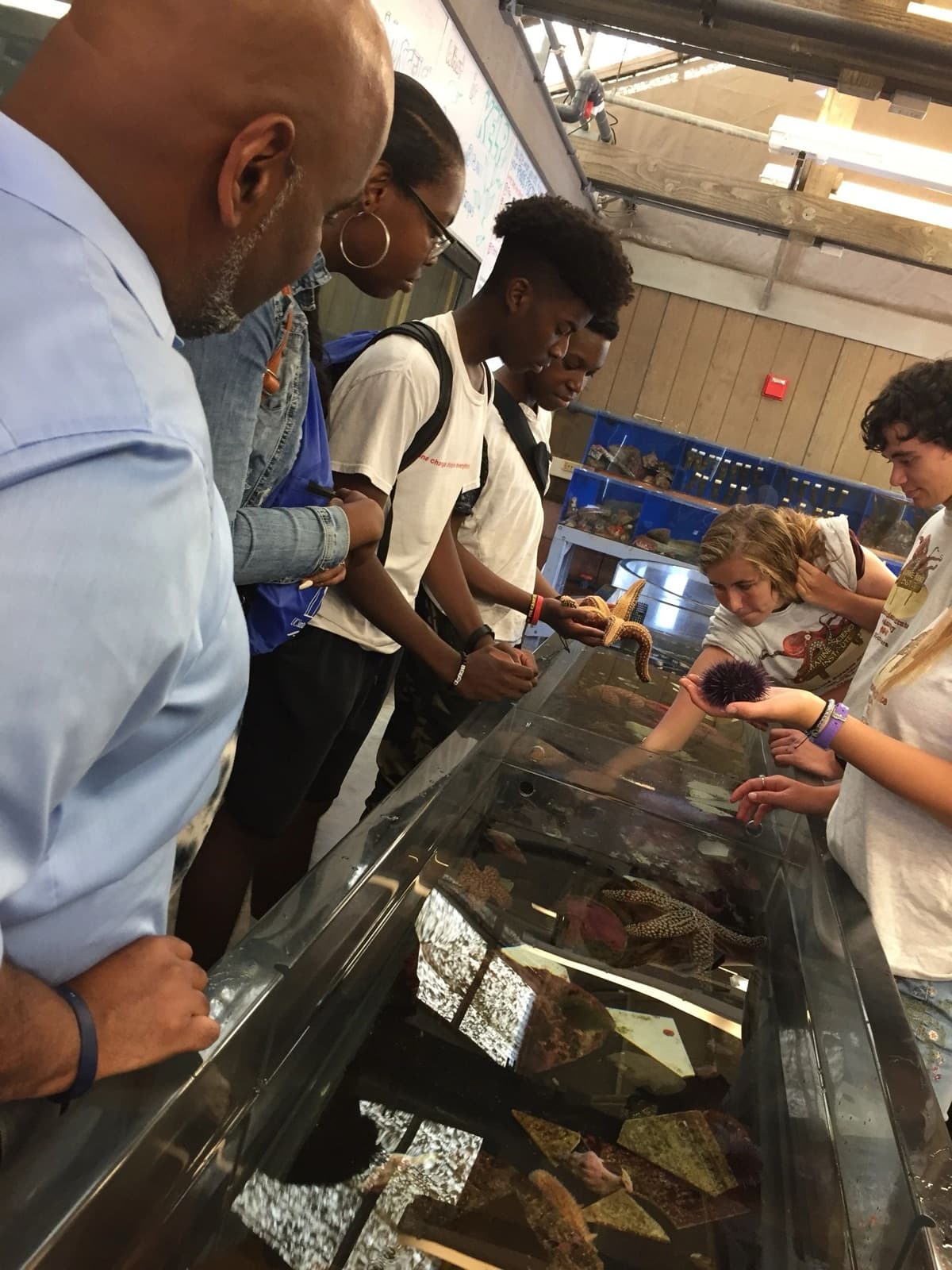
Picture a family at the kitchen table in October. The student has a laptop open and eleven tabs running. One tab shows a ranking, another shows a photo of a quad in autumn, and a third shows a tuition figure that makes everyone go quiet. The student says she wants to work in film, or maybe fashion, or maybe something with computers. Nobody at the table has been through this before. The question on the screen is which colleges to apply to. The question underneath it is harder: what would she actually be doing there, and where would it lead?
That family is an example, not a particular student, but the William H. Douglas Foundation exists for that table. We serve students and families for whom the college process is unfamiliar territory, and it is the reason our campus visit program, Xploration Tours, does not begin with a campus. It begins with a career. Every tour is built around the fields our scholars have named as interests, so that a scholar can see the line from the school in front of them, to the education it offers, to the work that education leads to.
This article explains why we build tours that way, and it sets out what research does and does not say about campus visits. We want to be careful on that second point. The evidence for visits is real, and it is also more modest than most college marketing suggests. Families deserve to see both halves, so we will give the findings, the limits of those findings, and our reasoning for the choices we have made. At the end you will find a short list of things to do this week, whether or not you ever travel with us.
The short version
- The best randomized study we found gave eighth graders three campus visits. They learned more about college, talked with school staff about it more, and were more likely to take advanced courses in ninth grade. Their plans to attend a four-year college did not change.
- A study of 2,274 rural North Carolina students linked campus visits to higher postsecondary enrollment, with formal visits showing the stronger association. It shows a pattern, not proof of cause.
- Roughly one third of bachelor's degree students change majors within three years, which is one reason we connect majors to real careers before a scholar enrolls.
- Information about net cost and options can change where students apply and enroll, even without a visit. A visit works best as one part of a plan, which is how we use it.
Why the visit is a question of access
Our mission is to deliver the access, information and resources students need to attend the college of their choice, regardless of socio-economic background. A campus visit touches all three. It is access, because a host college opens its doors. It is information, because a scholar sees what no brochure shows. It is a resource, because the scholar leaves with named contacts and a better list.
Visits are not evenly distributed. In the Arkansas research described below, reporting by Chalkbeat noted that only about half of the participating eighth graders said they had ever visited a college campus. Those students came from low-income schools, and most came from homes where neither parent had a college degree, according to the University of Arkansas. A student whose family has been through college may absorb a great deal about campus life without anyone planning it. A student whose family has not usually needs someone to arrange it.
Schools carry much of that load, and they carry it with thin staffing. The American School Counselor Association recommends one counselor for every 250 students. A February 2024 report from the California School Boards Association, drawing on ASCA data, put California at 464 students per counselor for 2022-23, against a national figure of 385. A February 2026 release from Rep. Linda Sánchez cited about 443 per counselor in California and about 376 nationally. The two figures come from different releases and may not measure the same year, but they point in the same direction. Counselors in California are stretched, and few of them can walk every student through a comparison of campuses and careers. That is no criticism of counselors. It is the gap that community organizations like ours try to help fill.
What the research says about campus visits
Search for this topic and you will find many confident claims, often repeated from one blog to the next. When we looked for the original sources, a number of the popular statistics could not be traced to a primary report, so we left them out. What follows comes from studies and reports we opened and read. Where we could read only an abstract or a summary, we say so in our notes at the end.
The strongest test: a randomized experiment in Arkansas
A randomized experiment is the closest education research gets to a fair test, because chance decides who receives the program. Researchers at the University of Arkansas ran one. According to the study's abstract, 885 students across 15 schools took part during 2017 and 2018. Within each school, eighth graders were assigned either to receive an information packet about college or to receive the same packet plus three visits to a flagship university during the school year.
The visits were planned with care. The university describes a first visit with a tour led by student ambassadors, a second built around interactive activities with academic departments, information on degree paths and dorm tours, and a third that was a baseball game or an on-campus scavenger hunt. Meals were included. In other words, one of the three visits was organized around what students could actually study, which is close to the idea behind our own tours.
The results, published in AERA Open in 2021, were encouraging in specific ways. Students who visited showed greater knowledge about college, put more effort into the study's survey, and reported more conversations with school staff about college. In ninth grade they were more likely to enroll in advanced math and in advanced science or social science courses. That last finding deserves attention from any parent of a young teenager, because course choices in early high school shape the options a student has later.
The study also found what visits did not do. Chalkbeat's report on the early version of the research said there was no change in students' plans to attend a four-year college. About two thirds of both groups already planned to go. Students were also less likely to plan on technical school, for reasons the researchers could not explain at the time. That early report also described the gains in knowledge and conversations as small, and it noted no clear effect on school engagement or on talking with parents about college.
We read that as an important lesson. Many students already want to go to college. Wanting it is not the barrier. The gap often lies in knowing what to do next, which courses to take, whom to ask and what a campus expects. The Arkansas visits seem to have moved those practical things more than they moved ambition.
Two cautions apply. The university's own summary reports no enrollment outcome, since these students were still young, and the researchers planned to follow them through administrative records. We did not find published college enrollment results from that follow-up. The study was also developed, run and paid for by the same university department that delivered the visits, and it was limited to one region and to volunteers.
A larger look at enrollment in rural North Carolina
For evidence on enrollment itself, we turned to a 2022 study in the Journal of College Access by M. Corinne Smith, Ross M. Gosky and Jui-Teng Li of Appalachian State University. They followed 2,274 students in 11 low-income, rural school districts in western North Carolina. These students entered the federal GEAR UP program in seventh grade and stayed at a participating school through graduation.
The authors separated formal campus visits from informal educational field trips to a campus. Both were associated with postsecondary enrollment, and formal visits had the stronger association. Visits taken earlier in a student's school career also mattered. BestColleges, reporting on the study, added that the field trips were not statistically significant for the class of 2020 unless they took place in seventh grade.
This is useful, with a clear limit. The study had no control group, which BestColleges attributes to the pandemic's effect on enrollment. Students who choose to go on a visit may already be more interested in college, so a link between visits and enrollment does not prove the visit caused it. The study also did not count visits made outside GEAR UP, and it measured enrollment rather than degrees.
Visits inside a broader program
Campus visits are rarely offered alone. Chalkbeat's report mentioned a study of GEAR UP in Iowa that found a boost of 3 to 4 points in college enrollment, and it mentioned Oregon GEAR UP's own surveys showing about a 5 point rise in students' college plans. Those figures describe whole programs, not visits by themselves. The same report noted an older Upward Bound study that found no overall effect on college completion, though it did find some benefit for students with lower initial aspirations. In short, outreach programs can help, that results vary, and that no single activity carries the weight alone.
A warning worth hearing
One detail in Chalkbeat's report has stayed with us. A leader at Oregon GEAR UP described visits that backfired, with students feeling out of place on a campus. A badly designed visit can teach a student that college is for somebody else. This is the reason we care so much about who a scholar meets during a tour, and why we arrange time with current students as a planned part of the day. A visit should leave a student with better information about a place, including the information that a particular place is wrong for them, without leaving them feeling that all such places are wrong for them.
What information alone can do
To keep this fair, we should note that one of the strongest findings on college choice did not involve a visit at all. Caroline Hoxby and Sarah Turner tested a package mailed to low-income, high-achieving high school seniors. It held application guidance, information on net costs and fee waivers usable at 171 selective schools. The cost was estimated at about $6 per student.
The U.S. Department of Education's What Works Clearinghouse reviewed the study and rated it as meeting its standards with reservations, because of high survey non-response. In the review, the package raised the share of students who applied to a selective institution from 55% to 67%, the share admitted from 30% to 39%, and the share who enrolled from 29% to 34%. The review describes these students as among the top tenth of test takers, so the result does not automatically extend to every student.
The finding builds on earlier work by Hoxby and Christopher Avery. Inside Higher Ed reported that nearly 40 percent of the high-achieving, low-income students they studied used application strategies experts would regard as odd, such as applying only to a local nonselective public university and one highly selective school. Our takeaway is simple. Clear, specific information changes decisions, and low-income students often have less of it. A visit is one powerful way to deliver information. It is not the only one, and it should not stand alone.
Why we start with careers rather than campuses
A typical public tour is about the institution. A sophomore walks backward, the group hears about traditions, and everyone sees a residence hall. That has value, and we say so on our own program page. But it answers the question of what this college is like. A student with no family experience of college usually has a prior question, which is what college is for and how it connects to a job they can picture.
That is why every Xploration Tour is centered on a career pathway. Each itinerary starts from the fields our scholars have named. A cohort drawn to film and fashion visits the programs, studios and faculty that train people for those careers. A cohort drawn to nursing or engineering spends the day where those careers begin. This season's first tour was announced for October 24, 2026, at Arizona State University's Los Angeles campus, with a film and fashion focus.
We have three reasons for working this way, and each connects to the research.
Students change majors, and the choice has weight
The National Center for Education Statistics followed students who began college in 2011-12. Within three years, about one third of those in bachelor's degree programs had changed their major, and 9 percent had changed more than once. Rates varied by field. Among students in mathematics, 52 percent changed, compared with 40 percent in natural sciences, 32 percent in engineering and engineering technology, 28 percent in computer and information sciences, and 26 percent in health care fields.
Changing a major is not failure. Exploring is part of college, and many students are better for it. We would never tell a fifteen-year-old to lock in a life plan. Still, the data shows how many students choose a field before they know what it involves. A scholar who has heard a professor describe where graduates go, and has seen the work up close, is making a more informed first choice, and is better placed to make an informed second one.
Beliefs about majors are often wrong, and they can be corrected
Economists Matthew Wiswall and Basit Zafar studied how students choose majors, in a paper published in the Review of Economic Studies in 2015. They gave students accurate information about the characteristics of different majors and watched what happened to their beliefs. Students revised their beliefs in logical ways when they received the facts. Expected earnings and perceived ability mattered to their choices, but the authors found that personal tastes were the dominant factor in choosing a major.
We find that result reassuring, and it shapes our design. Students are not simply chasing salaries, and they should not be pushed to. What a person likes doing counts for more. The trouble is that a student cannot know whether she likes something she has never seen. Tastes can only guide a choice if a student has met the options. A day inside a program lets a scholar test interest against reality, which is what a tour built around a career pathway is for.
Time in college costs money
A bachelor's degree often takes longer than the name suggests. The University of Chicago Consortium on School Research reported in The Four Years Fallacy that, for 2014 college enrollees nationally, the four-year completion rate was 47% and the six-year rate was 64%. Time to degree has many causes, and we are not claiming a campus visit fixes it. But a family planning for college should plan with those numbers in view. Each extra term has a cost, so a clear path from major to career is a practical matter as well as an inspiring one. Our Foundation measures its success by enrollment, retention and graduation, which means the question of whether a student finishes matters to us as much as the question of whether she gets in.
How that thinking shows up on a tour
We build tours with host institutions rather than simply booking them. Foundation staff work with admissions offices and, where possible, with faculty in the departments our scholars have named. Each itinerary is written for the group traveling, so a cohort weighted toward nursing does not get the same day as one weighted toward engineering and computer science. Before an itinerary reaches families, we confirm the schedule, supervision ratio, transport, meals, accessibility and emergency plan.
Here is how each element answers something in the research.
- Faculty in the field. Where the host can arrange it, scholars meet a professor in a department they are considering, and hear about the careers graduates go on to. This addresses the knowledge gap about majors.
- Campus ambassadors. Scholars get unscripted time with current students, including meals. This is our answer to the warning about students feeling out of place.
- An admissions conversation. Scholars discuss what the institution looks for and what a competitive application looks like. This addresses the practical know-how that the Arkansas study suggests visits can build.
- Financial grounding. Scholars work with net price rather than sticker price, so they can estimate what a place would cost their family.
- A debrief. Scholars record impressions and connect what they saw to a career pathway with their advocate, then work that into their college list.
We also ask scholars to prepare. Participation is based on eligibility and a short interview, in which a staff member asks why this campus, what the scholar wants to find out and what they would do with the answer. It is not an exam. Students who cannot answer yet are usually redirected to a better fit, or asked to return after their next advocate session with a clearer question. Our aim is for each scholar to board with something specific to learn.
Why we encourage comparing several campuses
One visit produces an impression. Several produce a framework. A scholar who has walked a large public research university, a small liberal arts college, a regional comprehensive and an HBCU within the same year can say what they want from an institution in a way that reading rarely teaches. We know of no study that isolates the effect of a fourth visit, so we offer this as our own program judgment and not as a research finding. The Arkansas experiment did use a series of three visits instead of a single trip, and the North Carolina study suggests that earlier visits matter, which fits our preference for a cycle over a one-time event.
Local tours are $75 per scholar, with pricing of $150 for two, $225 for three and $300 for four or more. Out-of-state and international trips are quoted per itinerary, with travel and lodging at cost. Cradle to Career scholars receive priority placement when seats are allocated, and enrollment in Cradle to Career is not required to apply for remaining seats. The Foundation has no financial relationship with any host institution and receives nothing if a scholar enrolls. That independence matters. Our advocates can tell a scholar plainly when a campus they loved is a poor financial fit, and when a campus they dismissed deserves a second look.
What we do not claim
You will not find us saying that a campus visit guarantees admission, a scholarship or a degree. The research does not support that, and neither do we. Going on a tour does not affect a student's chance of receiving any scholarship. Here is where we think the evidence stands.
- Well supported by an experiment: visits can raise college knowledge and may steer students toward stronger courses early in high school.
- Supported by association: students who go on campus visits, particularly formal ones, are more likely to enroll in postsecondary education, though other factors may explain part of that.
- Not established by the studies we read: that a visit by itself raises college graduation, or that career-centered visits outperform general ones. We build them this way for the reasons above, and we would welcome more research on it.
We share this because of who we serve. Families trust us with something important, and our value of integrity applies to how we talk about our own programs. The fair way to see a tour is as careful research by a scholar, one step inside a longer plan of courses, applications and financial aid.
How to get the most from any campus visit
Whether you travel with us, with a school group or on your own, these habits apply. A public tour costs little, and with some planning it can teach far more.
Before you go
- Pick one career or field to investigate. It can change later. It simply gives the day a purpose.
- Look up the department, not only the college. See which majors connect to that field and ask whether a class or a meeting can be arranged.
- Run the college's net price calculator. Federal law requires colleges that take part in federal student aid programs and enroll first-time, full-time students to post one. It estimates what students in similar circumstances paid in a previous year, after grants and scholarships. Loans are not subtracted, so the figure is closer to what your family would really face.
- Write down three questions the website cannot answer, and decide who should hear them.
While you are there
Questions like these tend to reveal more than a tour script does. They are suggestions, not a formula.
- To a professor: Where do graduates of this major go in their first job? What does the first year of courses look like? How do undergraduates get into research, studios, clinical placements or internships?
- To a current student: What surprised you? Where do you go when you need help? When did you last think about leaving, and what kept you here? Do students who share your background feel at home here?
- To admissions or financial aid: What does a strong application from my school look like? What do families at my income level usually pay? Which aid continues after the first year, and what must I do to keep it?
Then watch the things no brochure shows. Is the tutoring center staffed in the evening? Do people linger in the dining hall? Would you feel comfortable walking here at night? Do you see students who remind you of yourself?
After you return
Write notes the same day, before memories blur. Rate the campus on the things that matter to you, and compare it with the last one using the same scale. Then change something: add a school to your list, remove one, or decide what course you should take next. A visit that changes nothing has only half done its work.
When to start
The evidence favors starting before senior year. The Arkansas experiment worked with eighth graders, and the North Carolina study found that earlier visits had an important association with enrollment. A middle school visit does not need to be about choosing a college. It can be about making college a real place and showing a student why ninth grade courses matter.
Middle school
Keep it light and open. Visit a nearby campus, attend an event, and let a student see that people work and learn there. Talk about what they enjoy. Ask a counselor about the courses that keep doors open in ninth grade.
Ninth and tenth grade
Begin connecting interests to fields. This is a good period to compare different types of campuses, close to home where possible. Our college and career guidance programs can help a family build a plan, and our workshops cover the road to college in more depth.
Eleventh grade
Make visits serve the list. Compare specific programs, ask direct questions about cost, and use what you learn to sort schools into those that fit and those that do not.
Twelfth grade
Visits now support decisions. Keep up with financial aid deadlines at the same time. Cal State Long Beach reports that the 2027-28 FAFSA and California Dream Act Application are open, with a priority deadline of March 2, 2027. College of the Canyons lists March 2, 2027, as the Cal Grant deadline for the coming year, with a September 2, 2027, date for community college students only. Dates can change, so confirm them with your school and read our guide to California financial aid deadlines. If you are weighing a two-year start, our guide to community college transfer walks through that route. Our scholarship finder is also open to explore.
A word on our namesake
William H. Douglas, Jr. finished the ninth grade before returning to the cotton fields full time in Henderson County, Tennessee. After Army service, he settled in South Los Angeles, earned his GED and studied mechanical drawing and tool design at Los Angeles Trade Technical College. He joined North American Rockwell as a janitor and retired from it an aerospace engineer.
His path was a career pathway, built one step at a time, with education connecting each step to the next. We think about that when we design a tour. Many of our scholars cannot yet see the steps between where they stand and the work they hope to do. Showing them those steps, in person, with people who walked them, is the reason this program exists.
What you can do this week
- Students: write down one career you are curious about, and find one college program that leads to it.
- Parents and caregivers: run one net price calculator together, for a college you assumed was out of reach.
- Counselors and community leaders: ask which students at your school have never set foot on a college campus, and start there.
- Anyone ready for a plan: start with our assessment, or read about Xploration Tours and submit an interest form.
- Supporters: if you believe every student should see where their education can lead, you can give to the Foundation.
Back at that kitchen table, the laptop will still be open and the tabs will still be there. The difference a good visit can make is modest and concrete: a student who can name what she wants to find out, a family with a real cost estimate, and a list with reasons behind it. That is what we are building toward, one scholar at a time.
How we checked this article
Program details come from the Foundation's own published pages. Research findings come from the sources listed below. For the Arkansas experiment we relied on the study's published abstract, the University of Arkansas summary and Chalkbeat's reporting on the earlier version, and for the Iowa, Oregon and Upward Bound figures we relied on Chalkbeat's summary rather than the original studies. This article is general information and is not legal, tax or financial advice.
Frequently asked questions
- Do campus visits make students more likely to go to college?
- They may help, but the evidence is mixed. A North Carolina study of 2,274 rural students found visits were associated with higher postsecondary enrollment, without proving that visits caused it. A randomized Arkansas experiment found gains in college knowledge and advanced course-taking, with no change in plans to attend a four-year college, and it had not yet reported enrollment results.
- What is an Xploration Tour?
- It is the Foundation's campus visit program. Each tour is built with the host college and centered on a career pathway, with a written itinerary, faculty contact where the host can arrange it, time with current students, an admissions conversation, net price grounding and a debrief with an advocate.
- Why do you build tours around careers?
- Students often need to see how a college connects to work they can picture. Federal data shows about one third of bachelor's degree students change majors within three years, and research suggests students hold mistaken beliefs about majors but revise them when given accurate facts. Seeing a field up close helps a scholar make a more informed choice.
- How much does a tour cost?
- Local tours are $75 per scholar, $150 for two, $225 for three and $300 for four or more. Out-of-state and international tours are quoted per itinerary, with travel and lodging at cost.
- Who can go on a tour?
- Participation is based on eligibility and a short interview. Enrollment in Cradle to Career is not required, but Cradle to Career scholars receive priority placement when seats are allocated. Families outside the program can apply for remaining seats.
- Does going on a tour help a student win a scholarship or get admitted?
- No. A tour does not guarantee admission and does not affect a student's chance of receiving any scholarship. Its purpose is to help a scholar gather good information and build a better college list.
- How early should a student start visiting colleges?
- Earlier than many families expect. The Arkansas experiment worked with eighth graders, and the North Carolina study found earlier visits had an important association with enrollment. Early visits can be light and exploratory, focused on making college a real place.
- Is a virtual tour enough?
- We found no study comparing virtual and in-person tours in the sources for this article, so we cannot give a research answer. In our program view, a virtual tour is a helpful first step, and an in-person day shows things a screen does not, such as how people treat each other and whether a campus feels right.
- What should we look up before a visit?
- Start with the department that matches the student's interest and the college's net price calculator. Colleges that participate in federal student aid and enroll first-time, full-time students must post a calculator, which estimates cost after grants and scholarships based on similar students in a previous year.
- Can our school or association work with the Foundation on a tour?
- Yes, a conversation is the place to start. Schools, families and funders are welcome to get in touch through the Foundation's website. Seats on any tour depend on what the host campus can accommodate.
Sources
- An Evaluation of the Educational Impact of College Campus Visits: A Randomized Experiment, University of Arkansas ScholarWorks (Swanson et al.)
- New Study Suggests Campus Visits Inspire Eighth-Graders to Prepare for College, University of Arkansas News
- What can college visits do for middle schoolers? Get them taking tougher classes, new research hints, Chalkbeat
- Campus Visits as Predictors of Postsecondary Enrollment in Low-Income, Rural School Districts, Journal of College Access
- Rural Students More Likely to Enroll in College After Campus Visits: Study, BestColleges
- Beginning College Students Who Change Their Majors Within 3 Years of Enrollment, National Center for Education Statistics
- Determinants of College Major Choice: Identification using an Information Experiment, The Review of Economic Studies (Wiswall and Zafar)
- WWC Review of the Report: Expanding College Opportunities for High-Achieving, Low Income Students, What Works Clearinghouse, U.S. Department of Education
- Coverage of The Missing One-Offs by Caroline Hoxby and Christopher Avery, Inside Higher Ed
- U.S. student-to-school counselor ratio improves but still misses recommended rate, California School Boards Association
- Sánchez Introduces Legislation Designating National School Counseling Week, Office of Rep. Linda Sánchez
- The Four Years Fallacy, UChicago Consortium on School Research
- GEN-13-07: Guidance on Implementing the Net Price Calculator Requirement, Federal Student Aid, U.S. Department of Education
- Current Undergraduate Students: Financial Aid, California State University, Long Beach
- Financial Aid Important Dates, College of the Canyons